)-2.png)
Improving Jumps and Leaps: Why Strength Matters More Than Repetition
- Leah Bueno DOMP, COMT, MMP

- Apr 3
- 3 min read
Big, powerful jumps are a goal for many dancers. It’s easy to assume the best way to improve jumps is simply to do more of them. And while repetition plays a role, it’s often not the missing piece.
If jumps feel heavy, low, or inconsistent, the issue is usually not effort — it’s capacity.
At Performance Pilates and Rehab, we focus on helping dancers build the strength and control needed to create height, power, and endurance in their jumps, rather than relying on repetition alone.

What Actually Creates Height in a Jump
A higher jump doesn’t come from trying harder in the moment. It comes from how much force your body can produce against the floor.
This depends on:
Strength in the glutes, hamstrings, and quads
Power through the feet and calves
Coordination and timing through the entire body
When these systems are working together, the dancer can push into the floor more effectively — and the floor gives that energy back as height.
If the strength isn’t there, repeating jumps often just reinforces the same height over and over.
Why Repetition Alone Isn’t Enough
Practicing jumps improves coordination, timing, and musicality. It teaches your body how to organize the movement.
But if a dancer lacks the strength to produce more force, doing the same jump repeatedly will not significantly increase height. Instead, the body may start to compensate — relying on momentum, gripping in the wrong muscles, or losing alignment to try to get off the ground.
Over time, this can lead to:
Plateaued jump height
Heavier landings
Fatigue during combinations
Increased stress on the joints
To truly improve, the body needs to be stronger — not just more practiced.
Strength Training for Better Jumps
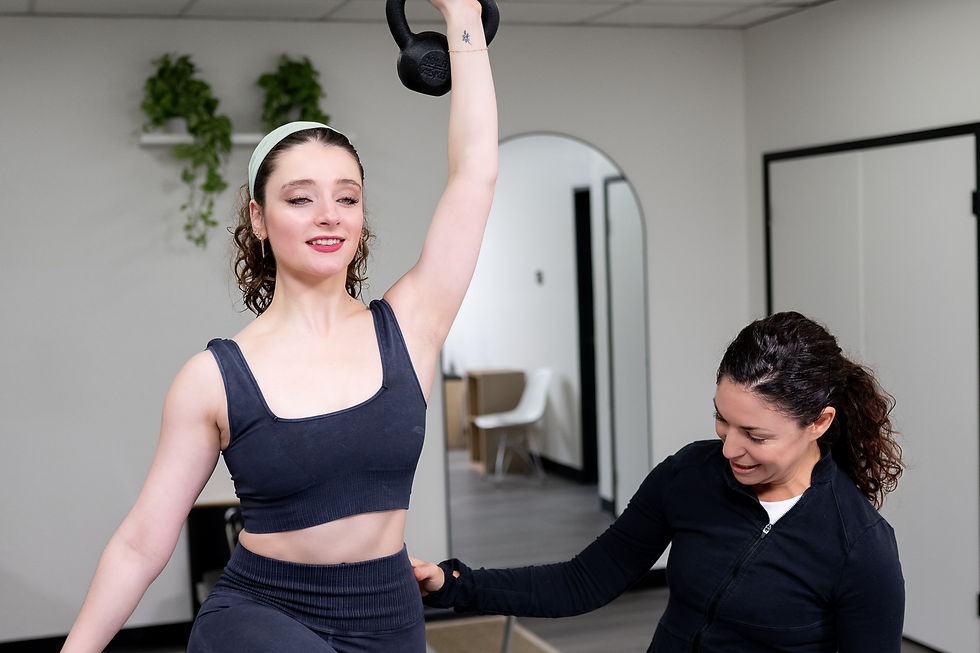
Strength training builds the foundation for explosive movement. When muscles are stronger, they can produce more force in less time, which directly translates to higher, more controlled jumps.
Key areas to focus on include:
Glutes and hamstrings for power and takeoff
Quadriceps for knee extension and support
Calves and feet for push-off and pointe strength
Core for control in the air and stable landings
When dancers train these muscle groups intentionally, they often notice that jumps feel lighter and require less effort to achieve more height.
Don’t Overlook Endurance
Many dancers can perform a strong jump once or twice — but struggle to maintain that height throughout a full combination or across the floor.
This is where muscular endurance becomes essential.
Without endurance:
Jumps get lower as combinations continue
Landings become heavier
Technique starts to break down
Risk of injury increases with fatigue
Training endurance helps the body sustain power over time, not just in a single moment. This is especially important in class settings, rehearsals, and performances where jumps are repeated frequently.
Control on the Way Down
Improving jumps isn’t just about getting into the air — it’s also about how you land.
Strong, controlled landings require:
Eccentric strength (muscles lengthening under load)
Joint stability through the hips, knees, and ankles
Proper alignment
When dancers lack control in landings, more force is absorbed by the joints instead of the muscles. Over time, this can contribute to overuse injuries.
Building strength helps absorb force safely and makes jumps feel quieter and more controlled.
A Smarter Approach to Training
The most effective way to improve jumps and leaps is to combine skill work with strength and conditioning.
Skill training improves coordination and timing
Strength training improves power and height
Endurance training improves consistency
When all three are trained together, dancers don’t just jump higher — they jump better.
The Performance Pilates and Rehab Approach
At Performance Pilates and Rehab, we help dancers build the physical capacity behind their technique. Instead of just repeating jumps, we focus on strengthening the muscles and systems that make powerful, efficient movement possible.
Because better jumps don’t come from doing more jumps.
They come from building a body that can produce more power, sustain it, and control it — every time you leave the ground.


Comments